I. Introduction
Chapters 15 and 16 speaks about an Oracle concerning Moab. Based on Genesis 19:30-38, Moab's ancestor was Lot and his elder daughter in an incestious relationship after the aftermath of the destruction of Sodom and Gomorrah. His younger daughter also had an affair with him and from there came Ben-Ammi, who became ancestor to the Ammonites.
 |
| Credit: See Footnotes |
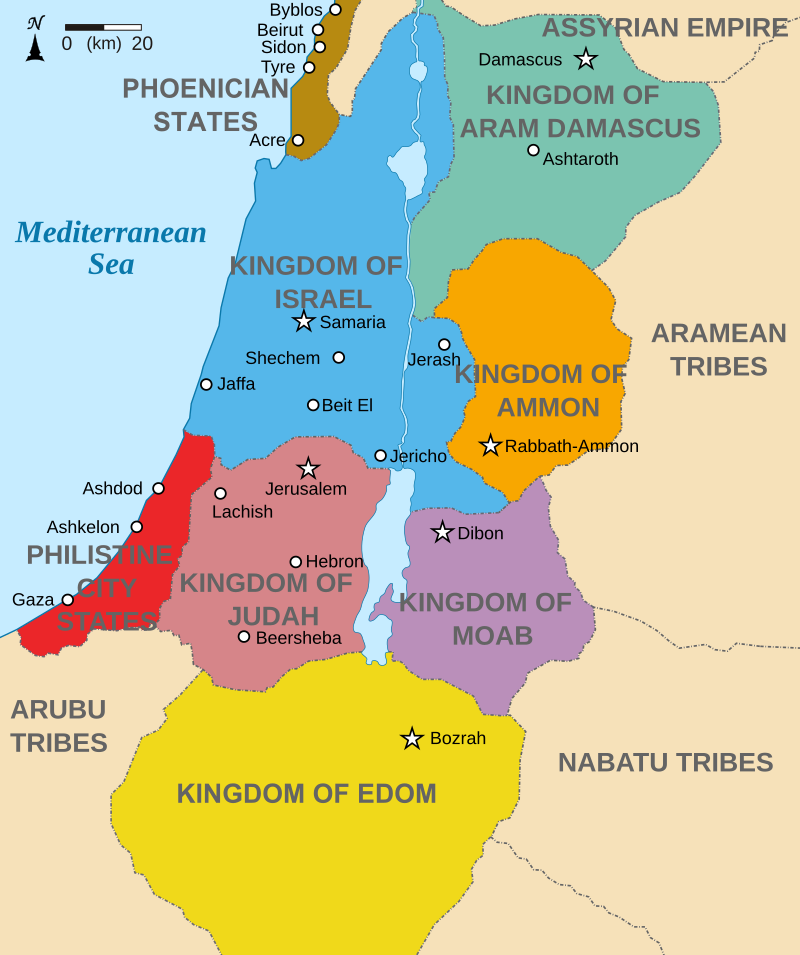
The Moabites and Ammonites warred with each other and eventually took territory on the right side of Jordan river, with Ammon at the upper part and Moab at the lower parts next to the Dead Sea.
God renewed his covenant with the Israelites at Moab before the Israelites entered the "promised land" (Deuteronomy 29:1). Moses was buried in an unknown location in Moab.
Moab was subjugated by David and became a tributary of Israel (2 Sam 8:2). However after the death of King Ahab, Moab refused to pay tribute and went into war with Judah. With the help of Prophet Elisha, Moab was defeated at Ziz, near En Gedi. (2 Kings 3)
The chief god of Moabites were Chemosh, and human sacrifices were offered to Chemosh. (Jer 48:7,13; 2 Kings 3:27). King Solomon built a "high place" for Chemosh near Jerusalem which God calls "the detestation of Moab" (1 Kings 11:7). It was only destroyed during the reign of Josiah (2 Kings 23:13).
According to II Kings, at times, especially in dire peril, human sacrifices were offered to Chemosh, as by Mesha, who gave up his son and heir to him.[27] Nevertheless, King Solomon built a "high place" for Chemosh on the hill before Jerusalem,[28] which the Bible describes as "this detestation of Moab". The altar existed during Isaiah's time and was not destroyed until the reign of Josiah (641-610 BC).
II. The Burden Of Moab (v1-4)
The fall of Moab was prophesied, starting with Moab cities in the north. The Moabites flee to their temples to plea for mercy, but their gods cannot help them. (15:2)
There was mourning everywhere, in sackcloth and the shaving of hair and beard. (15:3)
Heshbon and Elealeh were cities of Ammon, at the northern border of Moab. The cries of the Ammonites were heard all the way to the center of the nation, in Jahaz. The Moabites were terrified of the viciousness of the Assyrians. (15:4)
III. The Lamentation Over Moab (v5-9)
As the verses progress, it describes the advancement of Assyria to the center of the country, such as Eglaim and Dibon. (15:9)
Isaiah reflected God's sadness for the people of Moab as they flee all the way to their southernmost city, Zoar. (15:5) They took whatever little that was left of their food, and flee to the "Brook of the willows", which is at the southern border of Moab, next to Edom.
Footnotes:
* By Kingdoms_of_Israel_and_Judah_map_830.svg: *Oldtidens_Israel_&_Judea.svg: FinnWikiNoderivative work: Richardprins (talk)derivative work: Richardprins (talk) - Kingdoms_of_Israel_and_Judah_map_830.svg, CC BY-SA 3.0, https://commons.wikimedia.org/w/index.php?curid=10876701

No comments:
Post a Comment